Tuesday, May 31, 2011

MAY 2011 – LOTS OF COLD AND WINTRY DAYS

The month began with a very exciting visitor!
When Geoff picked me up from the train after a trip to Melbourne on Friday, 6th May, he said: “We have a new bird.” He showed me a couple of photos he’d managed to take through the lounge room window and I was VERY excited. Here he is:

It didn’t take long to identify him from the bird-books – he’s a Buff Banded Rail, very beautiful and, although reasonably common around most of Australia, very shy and not often seen. What is so very pleasing is that we’ve now seen him almost every day since that first sighting. He appears morning and evening for a bath in the (very small) bird-bath and then disappears into the undergrowth. We’re not quite sure whether we have one or two and, until we seen them together (if there are two) just won’t know. There are definitely two personalities: one is very relaxed and stands around preening for about ten minutes after his bath and the other scuttles off very quickly as soon as he/she is finished.

Here’s a four minute video taken from a total of about 12 ½ minutes.


Mushrooms
May is usually the time when we pick heaps of mushrooms in our paddock but this year they’ve been very scarce. Lots of moisture for them but just not enough warm sunshine. We gave away a total of about one bucket full and have only had about three meals. I think the time has passed now and we won’t see any more till next year.


The mushrooms are few and far between - and hardly any big ones.
Different year – a different season. I had a look at my photos and blog entry for May 2010 and discovered that most of the Australian shrubs were already flowering by now. This year, although buds are forming and there are a few flowers, they will be much later than last May.

Fruit and vegies.
The asparagus has been cut down and its roots put to bed for the winter. A generous dressing of pony-poo, a few handfuls of chook fertiliser and, when I get it, a blanket of pea-straw should keep them warm and well-fed ready for new, juicy shoots in the spring.


Silver Beet’s a staple in my garden and even if the snails and bugs attack it, there’s always enough for a meal. It’s delicious, nourishing and grows without much effort from me.
The fruit trees – Apricot, Nectarine and Plum – are only young and haven’t produced any fruit yet. Now that they almost finished shedding their leaves, I’ll prune them soon and hope that next season they’ll do the right thing.

What’s happening to my Silver Princess?!!!
That was my cry when I noticed quite a number of dead leaves and branches hanging down amongst the healthy ones. The weather has been so cold and wet that I wasn’t doing my usual wander around the garden every day. Normally, I regularly spend an odd fifteen minutes or so in the garden just for enjoyment, as well as keeping an eye on how things are growing. Sadly, proper examination of the tree (E. caesia) revealed a bad infestation of scale. And I mean BAD!

Every branch I looked at had a thick covering of the rotten little animals and each leaf was being attacked as well. Some of the branches would have to be radically pruned and the rest thoroughly sprayed – probably for a couple of weeks, if the tree is to be saved.

I found some EcoPest oil at the local garden shop and armed with that and a new supply of Pyrethrum with Garlic, I began my assault on the tree. Oh dear! The more I cut off the more and more I found badly infested. After consultation with husband, Geoff, we decided that most of the main trunk – which was leaning at quite an acute angle – would have to go and we’d try to save the smaller branches that had grown up vertically from it. Here’s what it looks like now.

It has certainly been cut back within an inch of its life but I’m afraid there was no alternative. There was no other way of stopping the spread of such a virulent attack.
The rest has now been heavily sprayed and I’ll do it again next week. Fingers and eyes are all crossed, hoping it will survive.

Update on birds
After we’d been attacking the Silver Princess, we discovered that the Buff Banded Rail seems to be hiding under the Hakea – right next door to the tree where Geoff was using the chain-saw. We haven’t seen a nest and don’t want to disturb it, but that’s where he disappears to after his bath. We were a bit concerned that we might have frightened him but the next day he was out again at the bird-bath looking very relaxed. He’s even started to get a bit pushy; he jumped out of the bath and attacked a couple of Goldfinches which were getting too close for his comfort, so we feel he’s becoming very much at home.
A small flock of Silvereyes appeared in the garden in the last week of May and I found a couple of them going all over the Indigofera Australis, picking off any small bug or caterpillar that was attacking it. We could have done with about a thousand more of them to rescue the Silver Princess!
A baby Fantail has been introduced to the bird-bath by its parents; a family of New Holland Honeyeaters - parents and noisy children – come and go regularly; and we still have the Shrike Thrush hopping about and serenading us. We also hear and occasionally see, a Golden Whistler – only the female though. We’ve only ever seen the male once in the last seven years.

STOP PRESS ON THE RAIL
The first day of June – and as I was about to put the Blog up on the internet, I found our Rail up on the veranda. He walked right around the house and then appeared fossicking around in the garden outside my office. Definitely feeling much more at home. AND, almost certainly a different bird from the one which is so nervous and runs away after bathing. Do we have a pair? We’re very hopeful.

For more photos of the Rail and the garden in general, you can click here.

Saturday, April 30, 2011

APRIL 2011 – PRACTICALLY PERFECT AUTUMN WEATHER.

Mid autumn – and a wonderful time for sitting in the garden.

At last, a brief respite from all the lush growth that’s been happening during the wet summer and beginning of autumn. There’s been no need for constant work in the garden so we’ve been able to sit in the sun, and relax with friends and family - in between mowing the grass, that is. Geoff, has still had to get on that ride-on mower every week because, unlike most summers, there’s been no time when it’s even looked like browning off. It just keeps on glowing wonderfully green and growing wonderfully high!


Evening shadows after a perfect autumn day.
Pony Poo - $1 a bag! A distinct advantage of living in the country is the availability of good, cheap fertiliser. I find a couple of bags of horse or pony manure are quite enough to help nourish my garden over the winter. Having bought two big bags for $1 each, the contents is now sitting in a couple of plastic bins, soaking in water, all ready to decant onto the asparagus bed and any other vegetable beds as they become vacant.

The asparagus ferns need to brown off and die down before I’ll cut them, then I’ll cover the whole bed with pony poo, compost and then a layer of pea or sugar cane straw. It’s a voracious feeder and it produces such a heap of luscious spears every September to December, that I don’t mind the little bit of work it takes at the end of autumn.

A new Seed-bed set-up.
Last year I managed to germinate lots of different Australian native seeds in a very makeshift and ad hoc way. This year I’m getting organised with trays of seed pots and giving each tray its own little hot house. I’ve set them up an old BBQ trolley from which Geoff has removed all the heavy bits like burners, etc. Now, with a minimum of effort, I can place the whole table of seeds in any sheltered, sunny or shady spot I want to.
The centre tray was $7 and came with its own cover. I bought the others for $4 for four
at a 'Cheap Shop' and made a cover with wire frame and plastic. It's all working very well so far.
Very convenient and I’ve already been astonished at the results of planting seeds from the X. bracteatum in my home-made hothouse. They germinated in 6 days and haven’t stopped growing.
This is the home-made hot-house cover.

And this is what happened in ten days!


Perhaps they’re a bit early. If so, it’s a pretty safe bet that I can get another lot up and on their way if I need to.
I’ve also put in seeds from the Running Postman and am striking bits from X. viscosum (Sticky everlastings) and Chrysocephelum apiculatum.(Common everlastings). There are also four pieces of cardboard impregnated with seeds of the Swan River Daisy (Brachyscome ibiridifolia) which I put in at the same time. They came attached to some wine from Banrock Estate Winery; it’ll be interesting to see if they do actually grow. No sign of any germination yet.

Self-sown plants.
In various parts of my garden which are covered in mulch and left virtually alone, it’s very encouraging to find various plants popping up that have self-sown. In the biggest Bush Garden area there are a couple of Tea Trees, a Kunzea, and a couple of different wattles. Down in the Bog Garden at the end of the block, there is a very healthy Melaleuca (from the three bushes nearby) and I’ve just discovered three tiny Tea Trees of a kind I don’t yet recognise. There’s also a Blackwood Wattle and a Dogtooth Wattle growing very happily, both of which appeared a couple of years ago.
This is a very healthy Kunzea self-sown from a bush nearby.
The end of the Sunflower Circle
By the middle of April, the sunflowers had grown to their full height, had flowered beautifully for the bees and butterflies, and were beginning to drop their petals. Two small grandsons – Jack 6 ½ and Marley nearly 6 – came up to visit and enjoy the country for a couple of days. They marvelled at the circle, played inside it, admired the height of the plants, and had a good time shaking the tiny dying flowers all over themselves and each other. Then (with our blessing) they spent a very happy couple of hours demolishing the lot! They dragged the plants towards themselves and, as the stem cracked, went crashing to the ground covered in sunflower leaves and laughing hysterically. Luckily the ground was soft so they didn’t damage themselves too much. Then they broke the stems up (if they were thin enough) and dragged them to the green-waste bin. The thick ones they dragged to a pile ready for the tip. It certainly kept them entertained and saved their grandparents a lot of hard work.
Jack and Marley inside the circle.
By the second day they were getting so much enjoyment out of the garden, they decided to cart mulch down in the wheelbarrow and spread it over the centre of the circle – ready for next year.
You'd harldy know it had been there! But I'll keep the spot free of grass
for next year's Sunflower Circle.
Next jobs?
I’ve taken most of my last year’s pots and put the plants out into the garden: a couple of Kangaroo Apples, a Viminaria that I thought was dying but recovered enough to plant out, and a couple of Goodenias that also looked a bit sick and seem to be surviving, so now I’m ready to start again. There’s a cluster of self-sown Pussy Tails that I intend to try to thin out a bit and I hope I’ll be able to get them growing in another couple of spots around the garden. I’ve collected seeds from anything that I think will grow and am going to put my new seed pots to good use – that will happen in the next month or so. I’ll be transplanting some of the X. bracteatum from the seed pots before too long and, of course, there’s the ongoing problem of the too-healthy Dichondra. Any spare time and energy I have will probably be spent removing some of that – firstly away from smothering my good plants and eventually, trying to eliminate it from various areas.

I really didn't think the Dichondra would be such a vigorous grower.
It will have to be VERY firmly treated to stop it killing everything!
 Picasa album: There are lots of pictures of this month’s activities here, so feel free to browse all my pictures and make a comment on any. I'd be happy to hear from you.
Next month I'll be able to report on how (or if) my new seed beds are working.

Friday, April 1, 2011

AUTUMN – SEASON OF MISTS AND MELLOW FRUITFULNESS

Autumn
How could I not start with Keats when he describes this autumn of 2011 so well?

Mists we have certainly had in the mornings, with hundreds of spider webs outlined and sparkling with droplets of water; and mellow fruitfulness in abundance. In typical country style, friends and neighbours have been bringing peaches and pears, zucchini and various other marrows, and we have been able to send them back with tomatoes and silver beet. Not much more from our meagre food garden but enough to feel part of the sharing.
A curtain of droplet-outlined webs are all over the garden.
Apart from the occasional rainy night, the March days have been sunny, warm, and still, making it very difficult to leave the garden and come inside to work on the computer.

Constant pruning neededAbsolutely everything has been growing apace and therefore has needed pruning. Native shrubs, like the Hibbertias and one particular Hakea, that I have carefully nursed over the past few years, suddenly decided to grow so fast that they nearly strangled each other and smothered a poor little Correa nestled between them. I needn’t have worried for the Correa – as I pruned and pruned to uncover it, it had grown just as fiercely and was thriving underneath.
The Hibbertia (H. aspera) on the left, Burrundong Beauty (H. luarina cross) on the right
 almost killed the Correa in the middle.

Timboon Rail Trail
Easy walking and pleasant company - makes for a great day.
 A walk with a group of friends for about 8-10 kilometres on a local Rail Trail was a wonderful way to spend a cool autumn day. Cars were used to provide transport to the start and three were parked at the end to drive us to lunch at Timboon and then back to the start again. It’s a labour of love by a number of hardy volunteers who have worked hard to establish the track and keep it clear of weeds and overgrowth. Most of the old trestle bridges are falling down and unusable which means that the track has to take walkers down into the gully and up again – a definite bonus. Down in the gully, as small bridges cross the streams, there are ferns, fallen logs, mossy banks and all the delights of Victoria’s temperate rain forest. Quite a lot of invasive weeds too, unfortunately, such as the ubiquitous blackberry, Ivy, a St John’s Wort variety and quite a lot of exotic grasses.
We walked through about six to eight beautiful gullies.

I discovered a wonderful site for identifying weeds. You can go to this site: http://www.weeds.gov.au/identification/index.html, click on Weed identification tool and just by a short description of your unknown weed, you are offered a list that you can check in detail. That’s how I found the variation of St. John’s Wort. Very useful.


Paul Jennings and a re-forestation project.
On Sunday 20th March Paul Jennings and his neighbour opened their properties to the public to enjoy and Geoff and I drove the 45 minutes to be a part of it. It’s of great interest to us in particular because he started his project eight years ago, which is when we moved to Camperdown and began our own small contribution to native revegetation. Admittedly, Paul has 50 acres and we have one – just a bit of a difference! So it was just lovely to park the car out the front of a small forest and follow the arrow to a winding dirt path that took us through all the native trees that we’ve been planting and nurturing in our own place. There were various Eucalypts, Acacias and Casuarinas as well as numbers of ground covers and grasses.
Paul and his neighbour have had heaps of assistance from the Hopkins Point Landcare Group and a couple of other private and semi-government bodies – both with money and advice, whereas we have struggled to spend very little and learn as we go. This has meant quite a few failures and set-backs – particularly with the changing weather conditions we’ve had in the past eight years but, fortunately, Paul had many experts there and available for us to talk to about what we’re trying to do, and we received lots of help and advice about direct seeding, sources for native plants and places to go for further advice and assistance. It was lovely to be amongst a group of people all with the same aims and enthusiasms.
Unfortunately, I forgot my camera so I’ve had to use a picture from Paul’s brochure and I hope and trust I’ll be forgiven if I’ve broken copyright. I don’t think he’ll mind though, since we’re both working for the same thing.
You can see the small forest in the background of this picture.
Credit is formally given to the Landowner's Re-vegetation Project Open Day brochure
from which I obtained this picture.
Willing workers welcome!
We’re very lucky to have two large grandsons of 23 and 20 who are happy to visit Camperdown and contribute some strong muscles to the cause. On 26th Stefan and Alex arrived and began work on getting rid of some very large branches of the Dog Tooth Wattle (A. cultriformis) that had grown out and over the Pincushion Hakea (H. laurina) in the Bush Garden. I hadn’t realised how much it was smothering it and the other Sweet Scented Hakea (H. drupacea) next to it until it was all gone.

Don't tell me the young ones don't work hard!
I didn't know Alex (on the left ) was a plumber!
Not only was it smothering it but it seems, it was also hiding it from our beautiful Black Cockatoos. Only on the following day we saw a group of five fly over and, within half an hour, we heard loud cracking sounds as the birds dined happily on the Hakea nuts. That’s when I discovered that the tree was now too low for us to see it (and the birds) over the intervening Wattles and Grevilleas. I can’t bring myself to give the front shrubs a severe pruning, so I’ve now bought yet another Hakea laurina and planted it where we’ll be able to see it from our lounge room window. Only a year or two to wait for the nuts – I hope!

Native wild life
Nothing as exciting as koalas or wallabies I’m afraid, only bugs, grasshoppers, crickets, spiders, butterflies and skinks, but still native and still wild life. And such a wide range of them all, many more than we’ve seen in our garden in all the eight years we’ve been here. We’ve had some really interesting caterpillars, so I’ve reverted to my days as a mother of young children and have made a couple of caterpillar boxes and collected two sorts, with the hope that they’ll make cocoons and we’ll be able to see the moths or butterflies hatch out. Two of the smaller grandsons (5 and 6 years old) are going to visit us through the school holidays so with a bit of luck, there’ll be something interesting happening for them.
I'll be interested to find out what these turn into.


A shoe box, a piece of plastic and a jar of water
all make a great 'caterpillar box'.
A lot of photos from March with explanatory captions can be seen on my Picasa Album here.

Tuesday, March 1, 2011

FEBRUARY 2011 – IF THAT WAS SUMMER, I GUESS WE’VE HAD IT.

Brrrr!
I’m writing this a day late. It’s the 1st March, it’s the beginning of autumn and, in South Western Victoria, the weather has suddenly turned to winter! The morning temperature was about twelve degrees, the heater was turned on and we shivered over breakfast. So I guess that was summer. Perhaps autumn will be a little more traditional, with cool mornings but warm, still days. Hmm, I can but hope!


Vegetables: Tomatoes and Silver Beet – very little variety but plenty of food.

There wasn’t a lot of gardening activity on my part and the garden seemed to survive very well without it. We started picking tomatoes at the beginning of the month and for the last two weeks of February, have been picking 5 or 6 almost every day. These are mostly from the one grafted plant, “Health Kick”, which I planted late November. I haven’t staked it and the plant has spread far and wide all over the garden. This doesn’t seem to matter to the fruit – I simply hook them up over the stems as they begin to ripen and pick them when they are quite deeply red all over. They look – and taste – like a Roma and I like to leave them on the plant as long as possible to develop their full flavour.


The couple of big ones on top are the first from a couple of Heritage Italian plants given to me by a friend.
I’ve given quite a lot away and have also cooked up a big saucepan to freeze for soups and casseroles.
I also remembered an old recipe I used to do regularly and had totally forgotten about. Just cut the small tomatoes in half, place on a baking tray with a sprinkle of olive oil, celery salt and basil, and cook in a slow oven for about 30-40 minutes till they are almost dried out. This concentrates the flavour beautifully. When they've cooled, add a few drops of balsamic vinegar - absolute heaven! Served alone or on toast squares or a biscuit, they go beautifully with a glass of chilled white wine! And don’t we deserve something delicious after all our hard work?

Perhaps they don't LOOK all that attractive but I can vouch for the flavour.
The Silver Beet went to seed pretty quickly in January, so I planted another punnet of the coloured variety, Swiss Chard, and it grew so well, I started picking the odd few leaves a couple of weeks later. It’s now producing quite enough for a couple of meals a week.

An Excuse
One of the reasons for not doing too much gardening was a planned family gathering set for 19th February. This meant more time and energy went into house-cleaning and other preparations than I usually spend! (I’m much happier working in the garden than working in the house!)
We totalled twelve adults and five children for lunch and dinner Saturday, and breakfast and lunch Sunday. Fortunately, everyone brought food and it was a communal cooking and eating fest. They are all enthusiastic cooks – all the daughters and sons, as well as in-laws – so all Geoff and I had to do was sit back and let it all happen. Some of the family were staying at the local caravan park, and four adults and a baby stayed with us.
The visit of the four small grandchildren was the reason for the planting of the Sunflower Circle. I had hoped we could put a piece of carpet inside and they could play in there with books, games, tea-set, etc. However, the weather was NOT particularly kind to us. We managed to cook and eat outside and on the veranda but intermittent rain meant that the ground was wet and it was also very windy. Admittedly, okay for kites, and we flew those with great success. We also managed a big and highly disorganised game of cricket; but it was a bit wet and chilly for a Sunflower House.


Too wet for sitting in but Jack enjoyed peering through the leaves.

They  just love the space to run, play, yell and swing.
Australian Garden This IS supposed to be a blog about a Native Australian garden, and vegetables and sunflowers don’t really belong at all; so a quick report on what’s been happening in this department.
For a start, the Bush Garden, which has plenty of pictures on the Picasa site here, has developed to just where I hoped it would be as the grandchildren grew old enough to enjoy it. The two 3-year-olds and the two 5 & 6 year-olds had great times hiding there, running around, exploring and 'getting lost'! We even had one scary moment when an uncle was hiding up a tree and growled mysteriously. Six-year-old Jack wasn't 'really scared' - but it was a pretty exciting moment.
All the shrubs and plants are growing and they seem to be getting ready for a quite early spring. Lots of buds on the “Burrundong Beauty” (Hakea Laurina-cross), the Cootamundra (Acacia baileyana), the Yellow Mallee Gum (E. preissiana), and the Banksias.

Yellow Mallee Gum (E. preissiana)

Burrundong Beauty

Prostrate Cootamundra (A. baileyana) with plenty of buds.

Banksia spinosa
The everlastings have been flowering all through January and February and hardly look like stopping yet. More and more spiders are appearing and, as I was writing this, I checked on the internet to identify them. I found an excellent site: http://museumvictoria.com.au/spiders/ and have now got all the correct information about our most common spidery visitors. (Fancy spiders having their own "website". Sorry!)
We have heaps and heaps of Leaf Curling Spiders, quite a number of Scorpion Tailed Spiders (which are not as dangerous as their name suggests. It’s just that they have a tail that they curl up over their back) and our colony of Spiny Spider babies from December (which I always used to call Spikey Spiders) has spread far and wide and they can now be found all over the garden.
According to the website, none of them are particularly dangerous. I don’t make a habit of handling them but even if they did manage to bite, they would only produce a localised swelling or itching.
One of the grandsons, 5-year-old Marley, is a very keen bug-man so he had a great time examining them all.

A Menace!
I also have to report that the Dichondra has become far too invasive for comfort. It did seem like a good idea at the time – great coverage and keeps the weeds down beautifully BUT – how do I handle it now? The overabundance of water this season has given it the personality of an agressive invader and it is starting to give me sleepless nights wondering how to control it. Watch this space for further developments!

The Scaveola is still flowering bravely but that Dichondra
will HAVE to be removed from around it.
Picasa Pics Even if there doesn’t seem to be much to report, there’s plenty to see in the garden and it’s best appreciated by the pictures I’ve put on Picasa. Click here to browse through what’s flowering, what’s budding and what’s developing.

EARLIER ENTRIES
For earlier months' Blog entries go to "Previous Posts".
For earlier months' photos, you can click HERE.

Monday, January 31, 2011

JANUARY 2011 – SEEMS LIKE SUMMER - AT LAST.

Bad backs don't allow for much gardening
Just as well the garden didn’t really need a lot of attention because, with my back still somewhat delicate, the early part of January meant very little hard gardening work. However, as time progressed, it got stronger and stronger and with another long handled tool added to the arsenal of gardening equipment, lots more jobs got done.

A $2 hand tool from the Cheap Shop plus a mop handle made a fabulous tool
for hoeing out weeds, cultivating, and getting under bushes, etc.
Deaths in the family.
That last day of December, with its 40 degrees and searing winds, was too much for some of my quite well-established plants. Two Eutaxias, which had been in for about five years, decided that being flooded out for months and then suddenly baked in an oven was quite beyond a joke and quickly turned up their toes.
The Mint Bush which had died off on one side, finally gave up the struggle; and my Clematis, which had covered my garden shed so beautifully, is looking decidedly sick. I know it loses all its leaves and looks very dead for most of the winter, but I have grave doubts about whether it’s going to recover this time.

One dead Mint Bush ...

... and a dead Eutaxia ...


... and I'm pretty sure the Clematis has gone as well.
 Still many flowers …
Even though things died around me, plenty of others flowered happily. The Creeping Boobialla (Myoporum parvifolum) has been covered all month and is still going strong. There are two sorts and I can’t find any different names for them, so I call them ‘the fine-leafed one’ and ‘the other one’.
This is 'the fine leafed one' ...


... and this is 'the other one'.
they both have plenty of flowers, though and make a very
attractive and thick ground cover.
Every flower in the garden is still covered with heaps of butterflies and moths as well as bees, hover-flies and flying bugs of all sorts. I think (but am not sure) we even have some native bees. I’m still trying to identify them.

Vegetables
As soon as we got some regular warm weather, the tomatoes took off and are now producing great quantities of great big (green) tomatoes. We’ve picked two ripe ones so far but there are more on the way.
I planted some seedlings of multi-coloured Swiss Chard to take the place of the silver beet that had gone to seed last month. It’s growing apace and looking extremely edible. I’ll be picking some leaves of that very soon.
Some self-sown cucumbers, carefully transplanted by my small grandson, are doing well – lots of flowers and I’m hoping to see baby cucumbers in the next week.
That’s about the end of my vegetable endeavours this year. With my bad back and such a weird season, I haven’t bothered with anything else.

The Sunflower Circle
After some early worries with too much rain (again!) all the sunflowers are flourishing and growing apace. I’ve cut a circle of black plastic to cover the centre and after a couple of 38-40 degree days, the grass underneath is being nicely baked and killed. I’ve used the black plastic treatment before and find it works a treat. It’s cheap, effective and very good for the environment – no chemicals! It really works well for anything – thistles, oxalis, cape weed, in fact it kills anything that grows, including roots and bulbs.

With the excessive heat at the end of January the black plastic
is doing a fine job of 'cooking' the grass and weeds.
Once the grass is totally dead, I’ll get some carpet from the Op Shop to cover the ground, then we’ll have a little 'Sunflower House’ for the small grandchildren to play in; to read a book, have a tea-party, tell stories – surrounded by green walls and a yellow roof. I hope it works! There’s a family gathering here planned for 19th February which includes five small grandchildren, and I’d love it to be tall enough by then. I’m not sure though – they might have to visit again about a month later to see it in full flower.
P.S.  I'm writing this on 1st February and I’ve just measured the biggest ones again – 90 mm growth in two days! Maybe it will make a decent ‘house’ by the 19th Feb.

The pictures tell the story so much better
I’ve just finished doing all the captions to my Picasa album for this month. That really provides a lot more detail about what’s happening in the garden, so click here and have a look at it.

Friday, December 31, 2010

DECEMBER - A MONTH OF EXTREMES!

How many seasons can you have in one month?
December weather has been even more amazing than November’s, with unbelievable variations – from freezing cold and rainy to warm, summery days; more rain and ending on the final day of the month with 40 degrees and one of those hot northerly winds which, as I write, is managing to rip branches off any tree it can get hold of.

The Willow that the hard-working grandsons had just finished pruning
got a bit more unexpected pruning from the wind.
Coping with a "Bad Back"
Even more of a challenge for this particular gardener has been the advent of a ‘Bad Back’! Always hard to live with for anyone, a bad back for a gardener is doubly frustrating. The first two weeks of December were spent hobbling around almost unable to walk - much less bend - but after some careful and gentle treatment from an Osteopath, things slowly improved. Bending is OUT, as well as any sudden movement or turn. However, once I became relatively mobile again, husband Geoff and I developed a few special tools to help with some of the easier gardening tasks and enabled me to feel a little less useless.

Behold! The Long Handled Spoon and the Magic Pick-up Stick!
The spoon is great for getting underneath small weeds and digging them right out and the pick-up stick enables me to dispose of them into the wheelbarrow. It’s surprising how much I can get done just by wandering through the garden with these two implements, pulling the light plastic wheelbarrow with me. I’m not overburdened with patience so this helps keep me busy and productive and keeps my mind off the frustration of not being able to do EVERYTHING I want to!

Helping hands and strong muscles!
There has also been a very helpful visit from two big grandsons who offered to drive up from Melbourne and get some heavy jobs done for us. They happily (and sooo easily!) moved some very big stones to edge the driveway, a job which was far too heavy for either of us to attempt. They also trimmed the Willow tree and disposed of the prunings and generally made themselves VERY useful with weeding, lifting, carting compost, sawing branches, etc. etc.


Big rocks need big muscles!


Sadly, these muscles were too strong for my spade handle!

"Magic Sunflower Circle House"
Then came the fun project – a Sunflower House. I’d seen it on a TV program and it sounded like a great idea for when smaller grandchildren visit.
We marked out quite a large circle, the boys dug a trench around the perimeter and disposed of the grass. Then they filled it with compost and planted the sunflower seeds. I was very happy to email them one week later and report that almost all of the seeds had come up and were looking extremely healthy. Next comes deciding how many of these many plants we need to thin out. Too close and they won’t grow big and strong, too far apart and we won’t get the effect we’re after of a secret hiding place for small children. It’s going to be an interesting experiment.

Within a week, almost every seed came up. Deciding how much to
thin them out is the next decision.
Just add heat ...
After all the rain in spring, the sunshine and heat that arrived in the first week of December produced enormous growth everywhere - unrestrained, undisciplined, wild growth! The asparagus shot up from normal size to more than a metre overnight; the Silver Beet grew and grew and went to seed in a week; the tomatoes tripled their size in a week and suddenly produced baby tomatoes; and we have been inundated with broad beans from neighbours who just can’t eat all their produce and can’t give it away fast enough. Geoff is complaining that mowing the grass is just like painting the Sydney Harbour Bridge – he’s no sooner finished than he has to start again. And to think that a little more than a year ago we were complaining about a drought!

... and even more rain.
A day of sunshine and 34 degree heat around the 5th or 6th was followed by ominous black clouds that brought a hail storm and more days of rain. A farm dam on the edge of town broke its banks and flowed out over roads and down the hillside, losing gallons and gallons of precious water. Again, our block became soggy and, to my grave concern, one of my small Eucalypts was left in a puddle of water. A day or so later my fears were realised and, after experiencing some strong winds, when I went out to check I found it flat on the ground.


Not looking good.

Worst fears realised.
With the assistance of the big grandsons, it’s been propped up with a star picket and, so far, seems to be surviving. I will be watching and hoping for the next few weeks or months. Who knows? It may survive – anything is possible.

Grapes
It seems the wet weather isn’t appreciated by Geoff’s grapevines. The big one, which he’s had in for about four years and, for the first time, was producing loads of bunches of grapes, has developed something that looks remarkably like ‘black rot’. He had spray ready to treat it but every time he was ready to spray, the rain came again and it had to be postponed. There’s a little new, healthy growth happening at present but it’s probably too late for spraying to do any real good.
The three new vines that have been dotted around the house are perfectly healthy. We just hope they stay that way!

Skinks and butterflies
The skinks continue to enjoy the garden, whatever the weather turns on and everywhere we walk, there are little scuttling sounds in the undergrowth.
And the butterflies! They are everywhere – fluttering around anything that has flowers on it – sipping nectar, chasing each other in mid air, rising in a cloud when surprised by an interfering human – a wonderful sight to see, particularly when the sun is shining and the air is warm and still. We’ve had a few of those days in late December, and hoping for lots more!

Picasa albums
My photographic record of what’s flowering, what’s finishing and what disasters have occurred is all available on Picasa here.


Tuesday, November 30, 2010

NOVEMBER - IS IT SPRING YET?

Springtime arrives (sort of) – even though it’s nearly summer!

At last! The small seedlings that have been languishing through the winter and cold spring are on their way. I can see them growing day by day – just when I had almost given up hope. We’re still getting those cold snaps, though. Just can’t seem to shake them off for too long.
Milk Carton as seedling pot.
I don’t know where I read this but I’m giving it a try. After the milk carton is washed out, make quite a few holes in the bottom, fill it with potting mix and use it for the first transplant of a tiny seedling. When it’s ready to go out into the garden, cut the base right off the pot and settle it into the garden. Then you can slide the pot up and use it as a wind guard while the seedling becomes stronger. As an added bonus, it’s also quite good at keeping snails away.

Australian Bluebells – Wahlenbergia communis.
A wonderful plant with heaps and heaps of iridescent blue stars. I’ve grown it in various parts of the garden ever since we came here. Sometimes it spreads everywhere – as here

And sometimes it gets lost amongst stronger plants and disappears entirely. I’ve had some failures at transplanting clumps of it but this year – victory! There are now about four more sites where it seems to be very happy and I’m hoping it will stay for some years.
It’s not a plant for ‘tidy’ gardens. It falls all over the place, comes up in unexpected corners, and only blooms properly when the sun shines. But then, it gleams and sparkles.
It goes beautifully with golden Common Everlastings close by - Chrysocephalum apiculatum.


Many Photos on PicasaIt’s a wonderful month – now, after all our waiting for the warm weather to arrive. I’ve gone mad with the digital camera and have many, many photos of flowering Hibbertias, Melaleucas, Alyogynes, Eremophilas, Mint Bush, Native Iris, the list goes on and on and I have put them all – some in various stages of growth – on the November Picasa Album here.
Visitors
I was lucky enough to have some keen gardeners visiting this month and we had a marvellous time wandering around the garden and through the Bushland, discovering plants in full flower, some just beginning, others just finished. I did have a bit of a worry with trying to answer questions about botanical names and had to rush for my trusty spreadsheet. Fortunately I have been keeping good records – otherwise I wouldn’t have a clue about some of the proper names.

Visitor stress!
Does everyone stress out when visitors are coming? I have to admit that for the week before two lots of visitors were expected I was out there for an hour or so every day with wheelbarrow and spade, trundling heaps of mulch into spots that have needed it for the last month or so. Things that needed pruning were pruned, weeds were picked (or kicked!) out and husband Geoff got out for the final mowing until the place looked practically perfect. THEN, the weather bureau forecast rain from the Friday to Sunday! Thank you, Fate!
Fortunately, they were wrong. Friday was fine all day when the REAL gardener was here. Not so good on the other two days but at least we were able to enjoy it through the windows and we did get out on two or three occasions.

Many Skinks all over the garden.
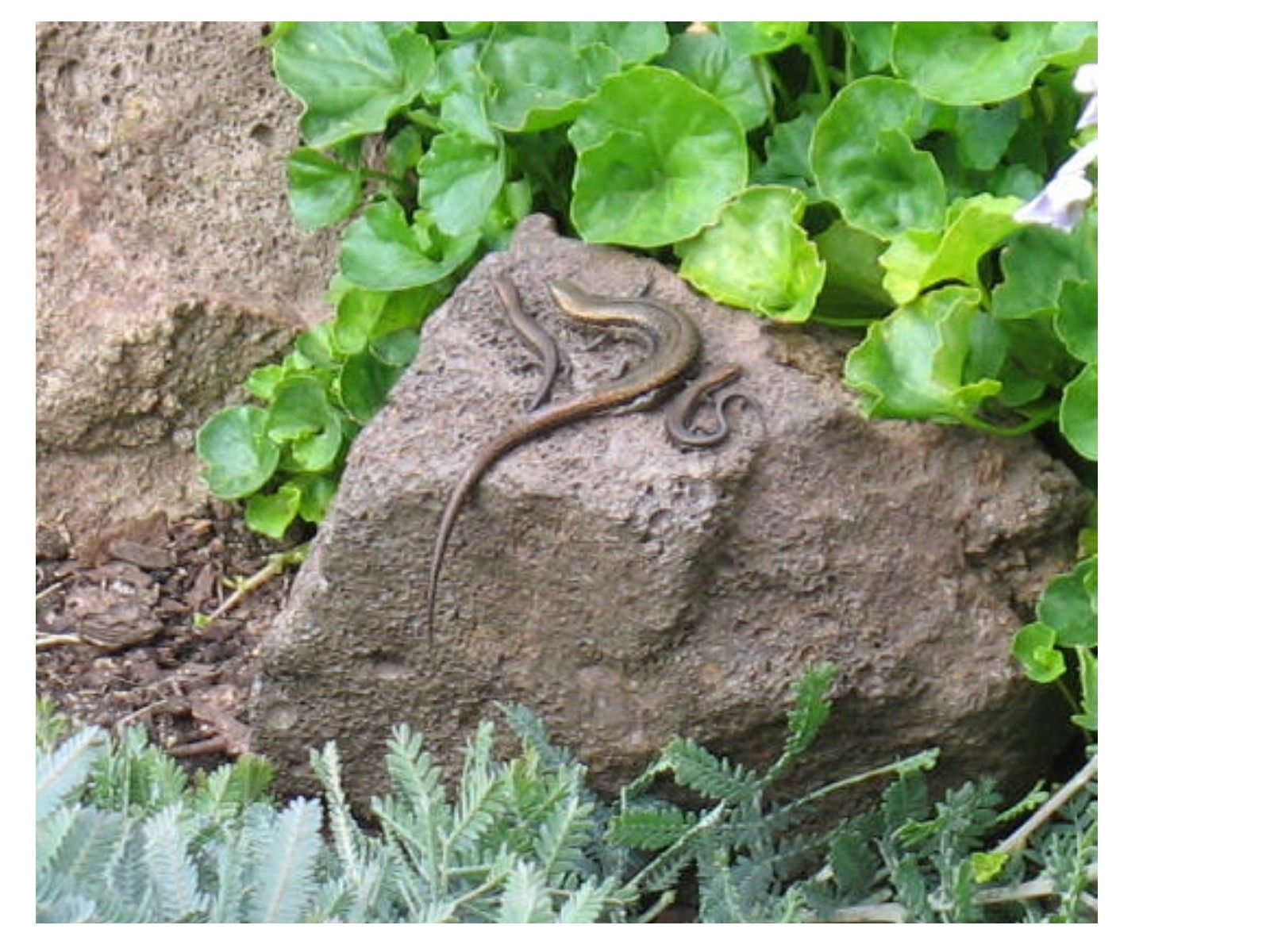
It’s been wonderful to see how the skink population has suddenly exploded. Everywhere we walk, suddenly there a flash of movement and a couple of skinks disappear into the undergrowth. We see them in the mornings, basking on the warm rocks in the early sunshine. I haven’t managed to photograph any this month but I caught a mother and babies out there last January when we had a bit more reliable sunshine.

Australian Shrike Thrush
Although we’re surrounded by English Blackbirds and their songs, we are also lucky enough to have the Australian Shrike Thrush as a regular visitor. It was a couple of years ago that I took this video of one at our bedroom window. The poor little fellow thought he’d found the love of his life and was serenading his reflection with great passion. They have a wonderful song – equal to any European song bird.


We also have our resident Wattle Birds, New Holland Honeyeaters, Thornbills, Scrub Wrens, and Magpies which live in our trees and patrol the block, chasing away the occasional Starling invasion. At this time of the year there are always baby birds on one sort or another. The baby Magpies and Wattle Birds keep up their constant squawking for food and I managed a couple of pictures of two Wattle Birds being fed on our fence a week or so ago.
The parents are very fair and alternate between the two – when they can. There’s always a scuffle for the next mouthful, though, and mum or dad are sometimes caught in the middle of an enormous scuffle. Very entertaining!


The Last Week in November and Wind and Rain are wreaking havoc!
I’m afraid I’ve become so used to drought conditions that I’ve been caught by surprise with all this rain. And it seems that others may have been too.
When I was buying a couple of Eremophilas a year or so ago, I remarked to the Nurseryman that I hadn’t seen many of these before. He agreed with me and said that, because they come from the dry desert area of South Australia, a few years ago he would never have sold them for growing in the ‘wet south-west of Victoria’. Now, he told me, with Climate Change, he is selling more and more of the West Australian and dry-country plants.
Well, that could all be changing again! In the last three weeks, with all the extra rain in November, I’ve lost two Acacias and one Banksia – all with ‘wet feet’. I mentioned last month that in certain parts of our block, I could hear the water trickling underground. This is obviously a VERY BAD THING for some of my trees, as you’ll see from these photos.

Banksia burdetti (from Geraldton)


Acacia "Scarlet Blaze"


Acacia implexa


The poor Acacia “Scarlet Blaze” was blown out by gale winds last month but, because it had quite a large tap root still in the ground, I tried staking it up again – to no avail. Then I noticed the Acacia implexa – which has been in since March 2005 and was growing beautifully – had started to shed its leaves. As I thought – it’s dying! Must be wet feet.
And so I checked a few others for similar signs. Not unexpectedly, the Geraldton Banksia (B. burdetti) was definitely showing signs of imminent death! Its leaves began drying and are now quite dry and curling. Another victim bites the dust!

I also found my Viminaria “Golden Spray” (V. juncea) had broken off and was flat on the ground after the rain and wind. It had heaps of flower buds and I suspect the rain made it too heavy and the wind was the final straw.
It’s all very sad, but obviously these different conditions have to be taken into account for future plantings.


Vegetables
I’m not growing many this year. I think I’m running out of energy and what I have I’d rather spend on the native plants. I have one grafted tomato and my latest visitor has presented us with two special Italian varieties which are doing well so far. I’m picking silver beet every day or so, and my small grandson has insisted on transplanting some cucumbers that came up from the compost heap. Against my prediction to him, they seem to be fine! And the one thing I really love, the asparagus, keeps on producing with very little assistance from me. That’s the sort of vegy I like!

Nearly Summer:Maybe by the time I’m writing the blog for next month we’ll be complaining about how hot it is! Meanwhile, there are lots more photos in the Picasa album for November. Just click here.