Wednesday, November 30, 2011

OCTOBER/NOVEMBER 2011 – SPRING FLOWERS AND SPRING RAINS!

A two-month entry – rather brief.
(I'm afraid life interfered with my regular Blog entries so now it’s time for quick a catch-up.)
A rather excessive amount of seedlings!
Absolutely ALL the Xerochrysum bracteatum seeds germinated in their little seed beds so, having left them a bit too long, I had to frantically select a few and plant out into various spots in the garden.
I’m afraid the rest had to be dumped – no space to put them and no time to re-pot or give them away. They are certainly well worth growing though – they produce lovely flowers and heaps of viable seeds.

I had to dismantle most of the bricks here to get rid of plastic under the
soil. Then I added a lot of compost and some mulch and now
have another good spot for a garden.
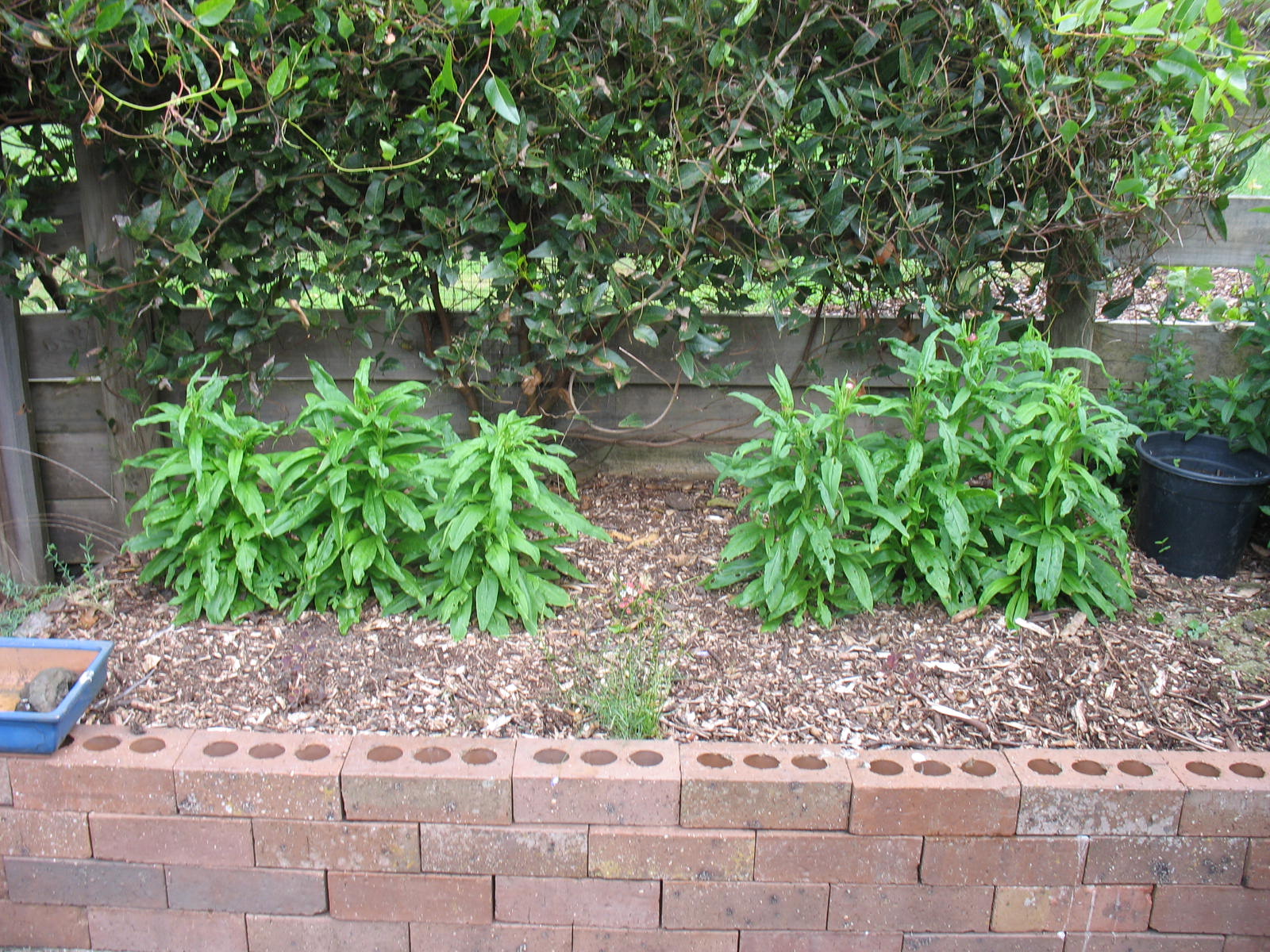
The plastic has been removed from this raised bed and now I’ve put in the tiny Geraldton Wax (Chamelaucium “My Sweet 16”) and the two Gastrolobium “Brown Butterfly” creepers, bought from the online nursery in September – plus a few of the Xerochrusum bracteatum seedlings. In the front in the middle is a trowel-full of roots of Bluebells (Wahlenbergie communis).

Here's how it all looks at the end of November. The X. bracteatum are about
to flower and everything else is growing well.
Flowering in October
Heaps and heaps of different plants come and go throughout the spring months. Some last for months and some only for weeks. Impressive ones have been: Eutaxia obovata, Orthrosanthus 'Blue Flags' (only one spike in this, its first year), Grevillea ‘Carpet Layer’, Matted Pea Bush (Pultenaea pedunculata), Prickly Tea Tree, Native Flax (Linum), Native Iris (Patersonia occidentalis), Hop Goodenia, Fringed Darwinia, Kangaroo Apple (Solanum aviculare) and many, many more. A lot of them are in the Picasa album for these two months and you can see them by clicking here.
But one has no flowers....
The one that has surprised me with almost NO flowers is the Grevillea ‘Winpara Gem’ which was a mass of red flowers at this time last year. It seems that it was reacting to the dry weather by flowering to survive but, now that we have plenty of rain, it now sees no reason to make an effort. Pity! This is what it looked like in October, 2010.
October 2010 - a fabulous display!
Flowering in November Some from last month continued to flowers and some new ones appeared. This was my month for the various Callistemons (Bottle Brushes). My son’s garden in Point Cook was ablaze with ‘Kings Park’ Bottle brushes back in late September but up here in Camperdown, we didn’t see them till November. We’ve also had an absolute carpet of white stars on the Pratia and that’s been going since mid-October. The Native Bluebells (Wahlenbergias) are growing well and whenever the sun shines they are a delightful blue haze in various corners of the garden. Unfortunately, we’ve had a lot of cloudy skies when they just sulk and won’t open. Much the same with the Cardigan River Carpet (Helichrysum dealbatum), a lovely paper daisy from Western Australia that seems to do quite well here. Flowering right through November we’ve had Lavetera, Viminaria, Hibbertias, Common Everlastings (C. apiculatum), , the ever-flowering Alyogyne ‘Elle Maree’, Melaleucas, Native Perlargonium, the big Willow Myrtle (Agonis flexuosa) and various Eremophilas. The Scaveola is a picture of lavender flowers, the Kunzeas are just beginning as are the Pussy Tails.

Disasters!
The unusually wet month again produced a couple of disasters. We lost TWO Eucalypts which were growing on the up-side of the block – both with VERY wet feet and consequently they simply broke off at the surface.
No comment!
So now I’m quite worried about other Eucalypts that are showing signs of dampness at the bottom of their trunks. We’ll just have to wait and see. It’s very discouraging, though!
I suppose that’s what happens when you come to a new place during a drought and then the whole weather patterns change. According to the locals, this is what it used to be like. I may have to change my whole outlook on what to grow here.
Vegetables
The Asparagus has been wonderful for all of the last two months, the more rain it gets the faster it grows, so we’ve been eating it almost every second or third day. It’s just about finished now and I’ll let it grow into ferns till next year’s crop.
Apart from heaps of Silver Beet, I haven’t grown much more this season. However, there are some tomato plants in now and they already have some baby tomatoes and are looking very healthy. Three small Golden Globe pumpkin plants should also provide some good food next year.

Plenty of work to do
I still have many of the new plants from the online nursery to put into the garden but they may have to wait until the Xmas season is over before I have much time available. Depending on how hot the summer is, they just might have to wait a lot longer. Gardeners do have to be flexible!

PicasaYou can identify all the flowering plants in the Picasa Album by clicking here.


Thursday, November 3, 2011

A SMALL PAUSE IN THE BLOGOSPHERE

Whoops! It's already November 4th and I haven't posted a blog for the end of October.
Unfortunately, pressures of life have interfered with my plans and I will have to miss out on posting until the end of November. Both the blog and the Picasa Album for October will just have to wait until I have a little more time available.
However - I will DEFINITELY be posting at the end of November and will catch up with the two month's activities - and photographs.
Meanwhile - the garden is a constant source of pleasure (and work!) and it's wonderful to see everything green and growing.

Tea trees are just covered with flowers.

The Eutaxia was a picture earlier in October.


Tuesday, October 4, 2011

SEPTEMBER 2011 - VISITORS AND NEW PLANTINGS.

Visit from Colac/Otway Australian Plants Society
Early in September I had an email from my cousin, also a very keen grower of Australian native plants, asking me if I would be prepared to have a group from the Colac/Otway Australian Plants Society come to have a look at my garden. My immediate reaction was “Aaarrrrgh!”
However, when I recovered, I went outside and wandered around, looking at the garden with an outsider’s eye. Eventually I decided that it was in reasonable shape and, with a little work, I could invite other gardeners to have a look at it without too much angst. I wrote to the secretary, Brendon, and asked him to suggest a date – not too far distant, as lots of plants are in bud and will be at their best very soon. He suggested Sunday, 25th September.
This decision promoted the immediate need for ‘a list’. All the things which needed to be done, should be done, or could be done were on the list; all the weeding, planting, trimming, tidying, and – most important of all – mulching. For that I needed the big grandsons and their muscles, so a call went out and two large boys (men?) turned up to assist.

Stefan and his brother Alex spread heaps of mulch
and we ended up with some very attractive paths through the Bush Garden. 
Spring plants. After winning the $100 worth of plants from an online nursery through Gardening Australia (see last month’s blog) I checked out their spring catalogue and made yet another list: plants I’d like, plants I must have and plants that sound interesting and a little bit different. There were some I wanted that they didn’t have in stock but I managed to order a fine selection of various trees, shrubs and ground covers. Some are to replace ones I have lost through drought or flood and there are some that are new to me, so I’m eagerly looking forward to their arrival. Nearly all are in 15cm pots as they are sent by mail, so there’ll be a wait of a year or so before I see them fully developed. Ah well, that’s gardening!

Watering pots!
I KNEW there was a reason I didn’t like growing things in pots! Because I had lost a few shrubs with wet feet over this last season, I bought two big pots for a new Grevillea and an Adenanthos (Woolly Bush). I made sure they were well drained, used good potting mix and settled them in comfortably. We had lots of rain for a week or so afterwards and then – yes – I forgot about watering them! Suddenly I realised that the Grevillea’s beautiful new bud was drooping! Fortunately it was rescued in time and I don’t think any permanent damage is done but …..!

So I have now bought a moisture indicator!
All I have to do is remember to use it! The advice on the packet says not to leave it in the pot so maybe I’ll have to put an alarm reminder on my phone. That should do it.

Seeds
A lovely warm weekend encouraged me to sort out all the seeds I’d collected last autumn and get organised for a big sowing session. Seed-raising mix, trays of pots, labels & pencil, spray bottle, watering can, and many envelopes of seeds – all gathered together and set out on the old BBQ stand which Geoff wheeled out into the sunshine for me – and I spent a very happy hour or three outside with the sun warming my back. By the time I’d finished I had sown seeds of Native Iris (Patersonia orientalis), Grass Lily, pink Alyogyne, Grevillea “Winpara Gem”, a mauve Native Violet from a friend and a whole tray of the big everlastings that did so well last year – Xerochrysum bracteatum. Everything is all beautifully labelled with date collected and date planted and, after all that work, I ended with a wonderful glow of virtue and a well-earned glass of wine!
I also planted out the X. bracteatum that came from seed I sowed in April. There were so many of them that I only picked the very strongest and discarded the rest. I collected so many seeds that I’ll be scattering the rest around out in the Bush Garden later this month. If they grow, fine. If not – I’m sure I’ll have more than enough anyway.

By the end of the month I have positivly hundreds of X. bracteatum - far too many!
Looks like some rapid thinning out is called for.
Arrival of plants by post.
I was very impressed with the promptness and the packing of the plants from the online store. They arrived about a week before the impending Colac visiting day, so I quickly re-potted them into something larger until I can find time to put them out into the garden.


Sunday 25th Colac visit.
We managed to turn on a lovely sunny day and had a great visit from five very keen and very experienced growers of Australian plants. It was great to be able to talk about our experiences and, because they had all been at it much longer than I have, they were able to provide me with lots of advice about taking cuttings, making seeds grow, etc. etc.

And with a little sun shining,
it looked pretty good.

This notice was to
show off the Bush Garden first!


I felt my garden was very small and new compared to theirs but I was quite pleased with the way it looked and they were all very encouraging. We plan to visit one or two of their gardens in the next month or so.

More pics.
There are many more photographs on the Picasa Album showing just how lovely the garden looked for our visitors. Just click here.
Meanwhile, enjoy your gardening.
Gillian the Gardener.


Tuesday, August 30, 2011

AUGUST, 2011 - WET AND COLD BUT A GOLDEN MONTH!

August 2010 v August 2011.
Now that this blog has been going for over twelve months, I can begin comparing how the seasons are different (or not). The heading I had for  August, 2010 was "Rain and wind - and more rain and more wind!" Well, we didn't get the wind quite as much, this year and, fortunately, we didn't get the floods that we experienced here last August. In fact, all things considered, it's been a whole lot less stressful than August, 2010.

A nasty shock
We did find a small disaster when we came home from a few days in Melbourne followed by a short visit to Swan Hill.
It wasn't even the wind that caused this disaster, one of the roots had just
rotted with all the water. 
This was where various family members had helped dig a drainage ditch for the trees. Apparently, it didn't work! I've tied it up to a star-picket but I know I'll have to take it out eventually. Oh well, maybe the little Coral Gum next to it will grow better then.

Glorious gold
Every week there's another wattle coming out and brightening up the countryside. I've got about sixteen different viarieties of Acacia and I love seeing them following each other through the months. I know that when one finishes there'll be something else to take its place. Have a look at the album on Picasa here. for many pics of the various wattles that are out this month. I've taken quite a few close-ups too, to show just how different their flowers can be.
This is one of my favourites: Gold Dust Wattle (A. acinacea)
Vegetables
Not much action in this department. We've been picking Silver Beet all winter and the asparagus is just beginning - we've had two small meals from that so far this season. I have a couple of garden beds ready for tomatoes but may not do too much more this year. Part of the reason for the Australian garden is to make it low maintenance and vegatables do require a fair bit of attention.

A fairly restful month.
With the weather cold and wet and most plants semi-hibernating, I've been doing much the same, so there's not much more to report.
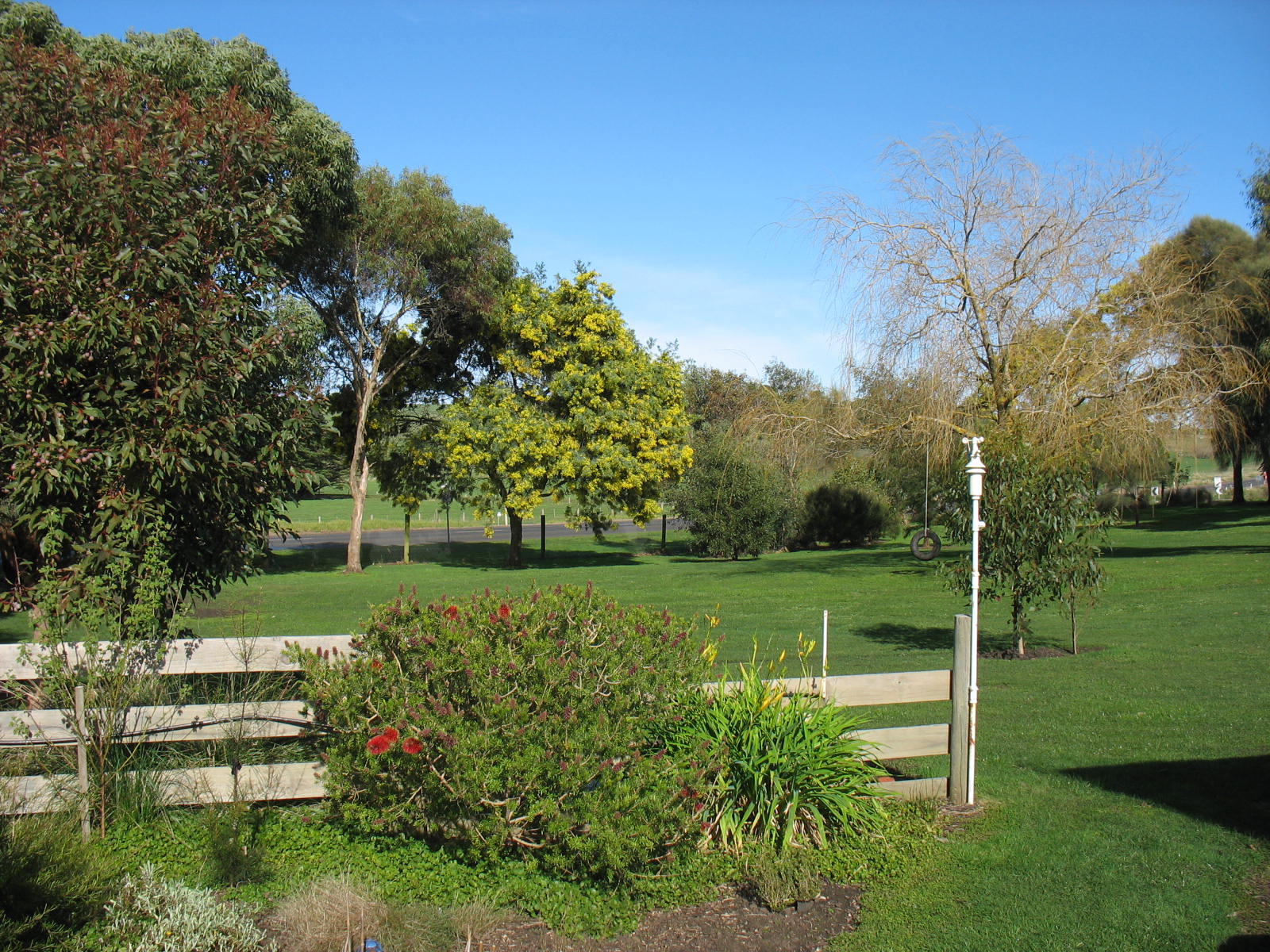
Coming in the front drive the garden welcomes us with gold, blue, purple and green.
The month in a album of photos
It's a short blog this month but there are still lots of photos with captions in the album, so click here.

Saturday, July 30, 2011

JULY 2011 – DEFINITELY MID-WINTER!

So I guess the drought has broken?

The rain continued to fall, the ground became soggier and soggier and I think spring will be VERY welcome this year. It's hard not to complain just a little bit about the rain and the freezing cold, but it's also great to see all the dams full and everything green and growing. It's certainly been a change to the climate of our first few years here and quite a number of the Australian natives are suffering from wet feet and may not survive. It just means we have to be flexible and keep learning, I guess. It will be interesting to see what the next few seasons bring us.

A couple of victims of the rain
Since 2003, I’ve already lost two Illyarrie Redcaps (Eucalyptus erithrocorys) through wet feet and it looks like the third one is going the same way. I’ve tried to save it by lifting and potting it but I’m not too optimistic. Well, it IS from West Australia so I don’t think I’ll try again. Unless …. maybe I’ll try just once more but START it in a pot.
I hardly disturbed the roots but ... I think it was looking unwell
by the next day.
The second casualty is the beautiful Grevillea “Superb”. I’ve been watching it look sicker and sicker for a couple of months and have now pruned it right back to see what will happen.

This is how it looked when I decided I had to do something about it.


Kill or cure! I really cut it back quite viciously and I'll be watching the many tiny shoots
deep inside the bush that were smothered with dead leaves to
see if there's any new growth.
 School holidays.
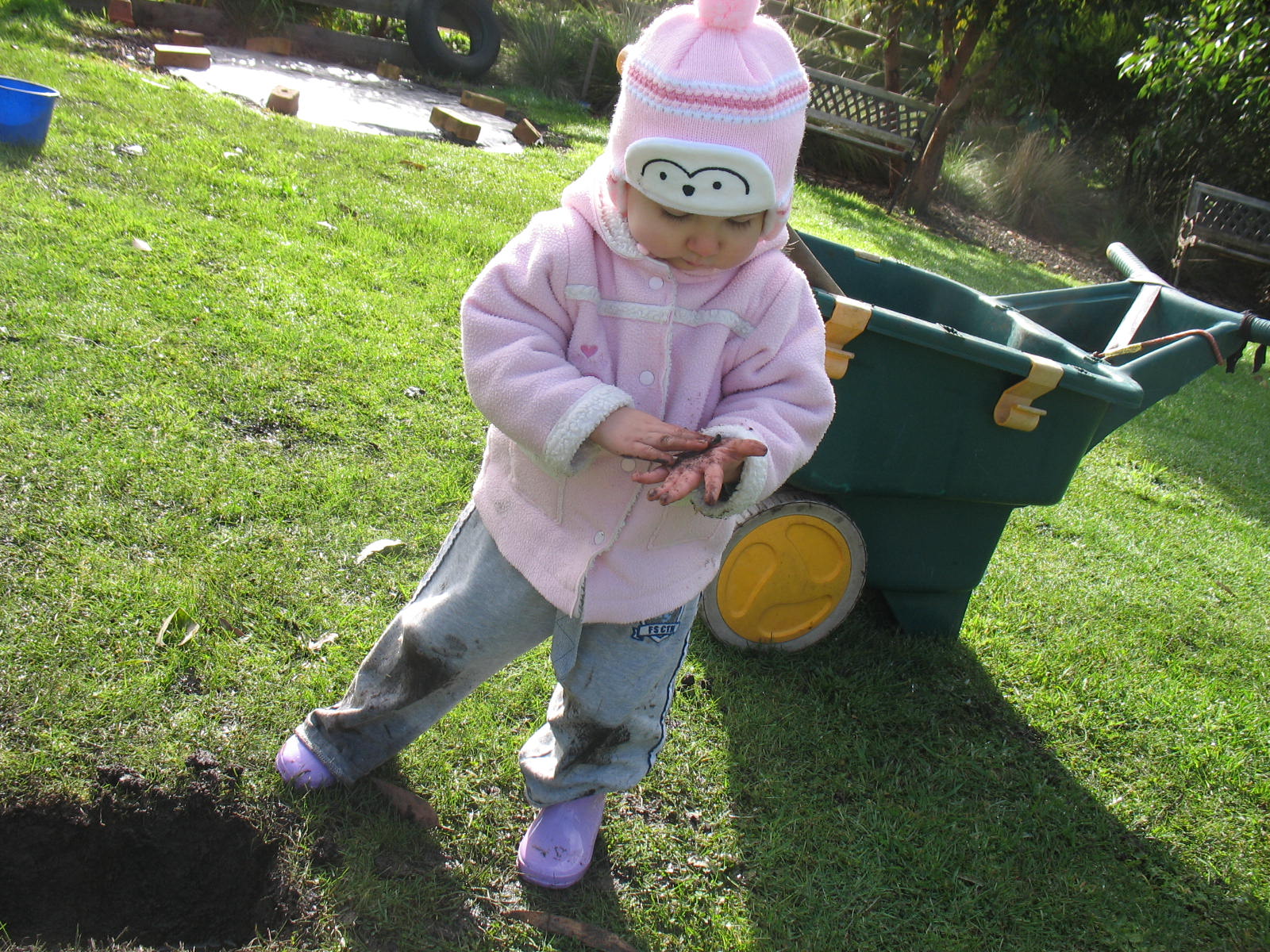
It was a month with a couple of family visits - and very welcome they were, too! Parents and children all gave much appreciated assistance in the garden. Early in the month we had all the Acacias along the drive cut back to stop branches falling onto the neighbour’s fence so there was quite a bit of mulching to occupy an energetic daughter and partner. Their small daughter just enjoyed getting to know about mud.


Trying to save the small trees
Another son helped with digging more of the drain from the small waterlogged Eucalypts and Olive (3) and Marley (6) thoroughly enjoyed assisting. They found the mud and the cold weather totally to their liking and loved getting outside to use up all their excess energy.


Ghost MothsThere were also plenty of the Ghost Moth cases left in the Bush Garden (see June’s Blog entry) for Marley to collect and take back for show-and-tell at school, and that kept him very busy and happy.

Moth hatchings
Just after the family had left, I discovered that my caterpillars had hatched. I had put them in a box way back in March and they had formed cocoons about three weeks later. And there they were, two lovely moths looking just like dried gum leaves.


Of course, I took lots of photos and have now printed them up and sent all the info down to the family – with one (very crumbly) cocoon. So sorry they missed it.

Gardening Australia – fame at last!
Around October last year I sent a proposition to a number of magazines, periodicals, newspapers, etc. suggesting that they might be interested in a regular gardening column based on my experiences here in the south-west of Victoria establishing an Australian Native garden. A few were vaguely interested but couldn’t provide anything definite. However, "Gardening Australia" suggested that I should put something into their ‘Your Say’ section and they would print the links to this Blog and to the Picasa Album. After replying and sending them a contribution, I heard absolutely nothing more – until nine months later - last week, in fact!
In the post I received a letter congratulating me on winning the “Letter of the Month” and enclosing an order for $100 on an internet nursery site. Now that’s a prize I really appreciate.
I have rung the online supplier and they are going to send me a spring catalogue and I can order from that or from my online browsing. I’ll probably wait for another month, till the weather warms up a bit, and then I can make my selections. Meanwhile, I can make up my wish-list. Great fun!

Buff Banded Rail
Sadly, we haven't seen our Rail since June 16th - reported in last month's blog. We carefully stayed away from anywhere he/they might be hiding in case we frightened them but there has been no sign all this month. That's about six weeks since our last sighting so I guess he's moved on. We're sad to lose him but feel very honoured that we had him for as long as we did - all of May and half of June. Maybe he'll return one day. Who knows?

Fruit trees and Asparagus
About a week before the end of July, the Nectarine needed spraying for leaf-curl. It’s now had itssecond spray – just before the buds begin opening. It’s all in the timing – I hope I’ve got it right.
The Apricot buds are beginning to open and the Plum is not far behind.
I covered the asparagus bed with compost, on top of the pony-poo, and just in the last week of July, I found two very healthy-looking shoots appearing. Could be a good year!


Spring – at least for one day!
The 31st July and we have a blue sky, slightly warmer wind and wattles. Now THAT lifts my spirits!

More pics and comments at the Picasa site here.


Friday, July 1, 2011

POST SCRIPT to JUNE POSTING

Ghost Moths
I found a heap of empty ‘cases’ in the bush garden in late June so on 22nd June, I sent off an enquiry to an entomology site I found online: 'kmebert@uqconnect.net'.  I was very impressed to receive a very comprehensive reply on 2nd July with all the information I could want.
I sent these photos:

You can see that all around them are holes
in the ground, so I assumed that's where they
came out.
It seems that the ones coming out of the ground are “Ghost Moths” of the family: Hepialidae and there are lots of species. “They have larvae that feed on the roots of trees below the ground. They make a burrow up to the ground surface. They pupate down under the ground but the pupa has circles of prickles on it and it can wriggle up the burrow with these gaining purchase on the wall of the burrow. So when it is ready to emerge to the adult (often in the winter time) the pupa comes up to the surface and projects almost all its length above ground before the adult hatches out and flies away. They are big brown or purplish moths, often with a few silver markings on the forewing. The adults don’t feed, but mate and die in a few days. The females are much bigger than the males and don’t come to lights as readily as the boys. If you have so many hatching in your garden then you should have had a few fluttering at your house lights.”
I have certainly heard bangings and flutterings at the windows at night but it’s usually when I’m already in bed and it’s been so cold I haven’t investigated. I’ll check next time I hear them.
This one was sticking out of the tree and when we touched it, it spilt rain water
all over my son - much to the entertainment of his wife!
The one coming out of the Acacia is similar and is called a Wattle Goat Moth. The larvae burrow into the tree and can live there for up to four years before emerging. This explains some of the big holes I've found in other Acacias.
I was so pleased to find all this out so quickly that I didn't want to wait till next month to post it on the blog.

Wednesday, June 29, 2011

SO THIS IS WHAT THE SOUTH-WEST IS SUPPOSED TO BE LIKE!

Wet and windy - yet again!
June has been cold, wet and windy and, with the amount of rain in the previous twelve months, our whole block has become soggy very quickly. It seems our first seven years here were un-typical. THIS weather, we are told by the locals, is the norm! But so many Australian natives bloom in the winter that the garden still manages to look bright and flowery; and before much longer, we'll be surrounded by the golden light of the wattles. No complaints about that!

These poor little Eucalypts - they've hardly had a week without wet feet.
A small drain MIGHT help but I fear for their future! 
“Our” Buff Banded Rail
He (or she) is still with us – that’s nearly two months, now. There was a while during this month when we didn’t see him for nine days and we had both decided he’d moved on. However, on the tenth day her turned up again and, for the first time, sampled his new, and deeper, bird-bath. He definitely approved, ducking his head under time and time again and splashing water in all directions.


We still don’t know where he’s living but there are a number of very dense bushy areas that would hide him (or possibly two of them) completely. We don’t go searching though in case we frighten him away. Our dream is to some day see two adults and some babies come marching out.

Spraying and Pruning.
With the three fruit trees – plum, nectarine and apricot – I had to do a bit of maintenance. The Nectarine had to be sprayed for Curly Leaf. According to the local experts, it’s all around Camperdown and if we don’t spray there’s no escaping it. Then they all had to be pruned. The plum was getting much too tall so I checked up on the internet as to how much I could prune it back. “Cut it down to as short as you want it” was the advice I found, so away I went. It’s only in it’s third year here and we haven’t had any fruit yet. Let’s hope I haven’t killed it!

I was pretty ruthless with the pruning.
Time will tell whether it will survive and produce fruit.
New plantings called for.
Sadly, a really windy night around the 21st June ended the life of a Grevillea outside the lounge-room window where we sit and watch all the birds.


There’s also a Grevillea “Superb” in the same area that has looked very unwell for over twelve months. I think too much rain has had a bad effect on it. There’s also the possibility that the Dichondra and Pratia, which have grown totally out of control since the rain, are strangling its roots. I’ve tried to keep a clear space under the shrub but it’s looking extremely sick and I think I’ll have to replace it. I may invest in a large pot for a new Grevillea “Superb” and surrender the fight to the creepers.
STOP PRESS:
I've bought a replacement for the Grevillea Superb and put it into a big pot. I’ll wait and see whether the original one recovers – which would be nice. If not, I can put the pot in its place and meanwhile, its getting established and growing a bit bigger - and it's covering up the remains of the broken one behind it.

This pic was taken in the last week in June when we suddenly had
a burst of sunshine. A very pleasant change!
Mostly a time for staying indoors
Fortunately the grass has stopped growing at last and everything else is taking a bit of rest from its mad growth over summer and autumn. And that gives us gardeners a chance to rest too. It’s good to stay inside keeping warm and watch all that wild weather outside.

A burst of sunshine
The last week of June turned on some glorious blue skies and sunshine – still very cold, though. It encouraged me to plant out a few of the everlastings I’d grown from seed and strikes – not into the garden yet but into a couple of bigger pots so I can still keep them warm and out of the wind until spring.

“Ralph” the Rail.
We haven’t seen him now for about twelve days so fear that he may have moved on. After we bought him a beautiful new bath and all! How ungrateful.

Winter flowers
Thryptromene

Correa - "Pee Wee Pete"
Cheering up the garden with bright flowers at present are: Thryptomene, Correas, some Grevilleas, three Hakeas, Epacris, Goodenia and the never-stopping purple Alyogyne.


I'm looking forward to next month when we are again surrounded by our golden wattles.

More pics available:  
More pictures can be seen at: https://picasaweb.google.com/Gillian.Gardener/TreechangeAnAustralianNativeGardenJune2011#